I am heading home after a difficult day at work. Nothing bad happened. I actually accomplished a lot. The snow didn't drive me homewards. I wrote a letter of recommendation, talked to someone about a wedding, prepared for and led a church meeting, worked on a jurisdictional event, prayed, and did general office work. Yet, sometimes I wonder what gifts God has given me, and I am never sure if I use them to the best of my ability. I've been struggling with living a much deeper spiritual life - trying to stick to fixed hour prayer, praying an hour a day for my church, and being more intentional about my body and health. For all of that, and it has been fantastic, I still struggle with things. Are they idols I won't let relinquish? Or, is it humility that I want only the best for the people I serve and to whom I attempt to minister?
As I look back on this note, I notice the word "struggle" is overused, but it is the correct word in every place. What is this struggle about? And, how can I stay in it to the end where I, hopefully, will find a new strength and trust in what I can do, find strength in what I actually do, and trust how God uses me in the world?
I sometimes wonder if I'm the only one I know who lives with internal struggles. Don't get me wrong: I'm strong-headed, pretty sure of my intellect, and I have firm beliefs about certain things. I'm not a pushover. But, in those deep places of the soul, there remains an uncertainty about a lot of things in which I believe I should be more grounded. On good days, this manifests as awe. I ask, "How is it that I serve a beautiful congregation that deeply loves God and yearns to serve the world?" I marvel that I've been entrusted with people's stories, their joys, their pain, and their hopes. On other days I doubt.
In a struggle for faithfulness, I hope that I am not doubting God. Yet, in a way, I know that must be what is happening. In doubting my giftedness, am I not also doubting God's ability to use this cracked vessel of a life that is mine? I suppose that this is a confession: "Lord, I believe. Help my unbelief." Perhaps someday, maybe even tomorrow (?), I will face the world in awe instead of fear.
Wednesday, February 23, 2011


Tuesday, February 15, 2011
God and Dog - Wendy Francisco
Living a life of simplicity isn't as easy as it sounds. Being open to the world, to love, to life, and to all of God's abundance is a challenge for most of us. I've read a lot of books, many of which have been helpful and many of which sit on my bookshelves filled with profound thoughts long forgotten. Every now and again, I run across something that is just true -
Dr. Seuss had a lot of wisdom in his writings.
When my cat sits in my lap and purrs - now that's pretty wonderful, too.
When a baby breaks into a smile
or when I can smell Fall creeping in from summer -
these remind me of life's simple graces.
Wendy Francisco has a new book based on her video and song "God and Dog." Some people may find reasons to fault this simple song/book, but I loved it. It made me smile. And, I think the world is short on smiles these days. Thank you, Wendy.
Wednesday, January 26, 2011
Micah 6:8 - Prayer by Walter Brueggemann
As I prepare for worship this week, I recall Walter Brueggemann's prayer delivered on Martin Luther King, Jr. Day in 1999. It is based on Micah 6:8. You may find this prayer in Brueggemann's book "Awed to Heaven, Rooted in Earth."
"Deliver us from amnesia
God of peace,
God of justice,
God of freedom,
We give you thanks for your cadences of
peace, justice, and freedom,
Cadences that have surged through the lives
of Martin
and Ralph,
and Rosa,
and John,
and Hosea,
and Jesse,
and Andy,
and all that nameless mass of risk-takers who have been
obedient to your promises
and susceptible to your dreams.
Deliver us from amnesia
concerning their courage in the face of violence,
their peace-making against hate,
and their hunger for you in a devouring economy.
Deliver us from amnesia:
turn our memory into hope,
turn our gratitude into energy,
turn our well-being into impatience.
That these same cadences of your will may pulse even among us.
Amen."
Sunday, January 09, 2011
Epiphany A - Something Dark
Something dark happened yesterday. A shooter walked into a Safeway in Arizona and let loose a barrage of bullets that killed six people, including a federal judge, a former social worker turned Congressional aid, and a nine year old girl. The target of the shooting was Congresswoman Gabrielle Giffords.
Every week when we assemble in worship, someone in this room brings something dark with them. During prayers of the people, we pray for people going through divorces, people living with addiction, nations and peoples torn apart by strife and war. We pray for people living with cancer. We lift up the names of families living with tragedy upon tragedy: suicides, deaths, financial ruin. The world is not short of dark times.
January 6 was Epiphany. Twelve days after Christmas Day, the Church celebrates the arrival of the magi or the Wise Men at the house of Mary and Joseph where they bring gifts to the Christ-child. Herod, who was the King of the Jews, was frightened by the news that a new “king” may be born. He called the Magi to him and commanded them to collaborate with him in eliminating this threat. Just a few verses later (16-18), Herod, in an attempt to quell his competition, sends his men to kill all boys of Jesus’ approximate age. This passage is often called the Slaughter (or Massacre) of the Innocents.
This political setting is important if we are to grasp the truly amazing nature of Epiphany. We cannot hope to experience the power of the light, the power of the revelation, the faith of the Magi, or the love of Jesus’ parents without fully grasping the peril in which they find themselves. Unlike Luke’s Christmas story, which is filled with angels singing, shepherds proclaiming, and cloths swaddling, Matthew gives us a grim tale of Jesus’ birth. Matthew begins with 17 verses of family lineage and then a few short sentences of verbal contortion to show how Jesus could be both the son of the Holy Spirit and Joseph. Joseph then has a dream that tells him not to put Mary away from him even though she is pregnant and then the birth, as such, which goes like this: “24 When Joseph woke up, he did what the angel of the Lord had commanded him and took Mary home as his wife. 25 But he did not consummate their marriage until she gave birth to a son. And he gave him the name Jesus.” That is the entire Christmas story. No inn. No wrapping him in swaddling clothes. No census. No manger. Stark and dark.
Into this walk the magi. The only thing we know about them is that they came from the east, they interacted with Herod, they brought gifts, and they fled. However, the lack of detail about them does not diminish the power of their witness. The story of the magi is filled with meaning: what they mean - what Epiphany itself means - is that by the power of God’s light the Word of God is revealed to all the world. Epiphany, the word, comes from the Greek word “epiphaneia,” which means “manifestation” or “revelation.” Epiphany is the celebration of God’s revelation or manifestation in Jesus the Christ to all the earth. God’s light splits the darkness of the world, and by its power, draws us near to the divine - even if we must walk through perilous places to get there, even if we must confront and be confronted by the powers and principalities of this life in dangerous and threatening ways. The magi, after giving Jesus their gifts, went home by another way, knowing that Herod sought them for no good end. Gregory the Great believed that this story meant that once we have come to know Jesus, we are forbidden to return the way we came to him. This story is about finding a new path in life - a path directed by God’s light, filled with God’s revelation, and known by our gifts.
God’s light does not ask for us to pretend that dark forces are not at work. The magi understood Herod’s nefarious intentions and responded to them. But, as the forces of this world try to keep us living in death and in fear, God’s light leads us by another way.
Whether one watches FOX News or MSNBC or listens to NPR, we are hearing spin on yesterday’s tragedy. This is tragedy upon tragedy. More than anything, what is happening in our public sphere causes me deep sorrow because in the midst of the darkness of our world, I see glimmers of God’s light at work in the world, desperately trying to lead us by another way. Is there not a less vilifying way to engage in public discourse? Is there not another way to discuss health care, immigration, abortion, taxation, trade agreements, government funding, homosexuality, and other difficult issues than to evoke mental images of Communism, Naziism, or Anarchy? Has the church no role in standing up and crying out for us to go by another way, and, by our own witness and example, show that God’s manifestation changes how we live in the world? People are hurting and our public discourse does nothing more than heap salt into wounds. We are not pursuing a common good. We are not lifting one another up in love and comfort. We are fighting like children, using grown up language and grown up tools. This is a dangerous combination.
Every day I receive articles - in magazines, online, and in periodicals - that talk about the demise of mainline Christian Protestantism. We live in a time and place that is suspicious about organized religion, that sees the hypocrisy in denominationalism, that shrinks away from choosing one “brand” of Christianity - or even religion - over another. But I know that the church is needed more than ever to bear witness to God’s manifestation among us. Our voice is needed to stand outside of partisan politics and to declare that there is another politics that claims our lives - God’s politics - and that this organization of public life relies upon personal and social holiness and leads to radical transformation. It is our holy and sacred duty to be strong in our Gospel proclamations and yet also humble, that we not fall into the hubris of believing we own this Gospel. We do not. It is something at work in our lives and in our congregations, changing us, leading us by God’s light onto paths down which we have not yet tread or mapped. This light leads us to confront governments that oppress and slaughter the innocents. It leads us to give the best of what we have and all that we are to the service of God’s holy and blessed word known and manifest in the weak and fragile bodies all around us. God’s light illumines our path and sends us into life by a different way, unable to return down the same path by which we came or even to remain the same people who first began our journey. The church is needed to be a place where soul conversation can rise above the partisan conversations that frame too much of our public discourse. The church is needed - the real church - the one that will repent when it is wrong, that seeks unity in God’s holy light, and that moves forward without apology to God’s holy dwelling place.
Something dark happened yesterday. And it will happen again. Today, tomorrow, and every day after that. But something light is also happening. And by this light, all the earth might be changed. We celebrate this light as we celebrate Epiphany, which begins a season filled with stories about call, transformation, and holy vocation. Walk this path with me. I would love to walk it with you. And, maybe at the end of it, we will wonder at God’s work in the world. Amen.
Wednesday, December 22, 2010
Christmas Children's Play - Sun, Moon, Star by Kurt Vonnegut
You know you pastor a cool church when the Christmas play is "Sun, Moon, Star" by Kurt Vonnegut. There are many Christmas pageants and plays for purchase. Many of them are very clever and funny. Most of them have nothing to do with Christmas. They are gimmicks contrived to "do something new with an old story." More precisely, they are gimmicks used to get churches to buy yet one more thing. Perhaps this reveals why I don't work in theater, but I think that the Christmas story is pretty interesting just as is. Angels, shepherds, birth, animals, stars, songs, love, danger, political intrigue, poverty, and riches - it seems to me that the original story has everything in it that a major blockbuster movie needs to be successful. Yet, I'm not beyond finding new ways to bring this most wonderful story to both children and adults.
Some authors who have found new and profound and even silly ways to tell Christ's birth include Madeleine l'Engle's "Sky Full of Children," which is all about creation, stars, and wonder. In it she asks, "Was there a moment, known only to God, when all the stars held their breath, when the galaxies paused in their dance for a fraction of a second, and the Word, who had called it all into being, went with all his love into the womb of a young girl, and the universe started to breathe again, and the ancient harmonies resumed their song, and the angels clapped their hands for you?" Sky Full of Children is a chapter within her book on the Incarnation called "Bright Evening Star."
Frances Tyrrell took the old Canadian/Native American Christmas song "The Huron Carol" and turned it into an illustrated children's book, which is pretty outstanding.
Author Mark Francisco Bozzuti-Jones and illustrator Shelly Hehenberger offer us a tale that rests on John 1 in their book "Jesus, the Word."
These are not plays, per se, but they are tales that may help people enter the Christmas story afresh. I have seen all of these turned into plays in one way or another.
Of course, I am a pastor, and I think the best Christmas story is found in the Bible. To be specific, I am most moved by Luke's story (sorry Matthew).
Here's Kurt narrating his own story.
Tuesday, December 21, 2010
Christmas and START - Dreaming of Peace
The New Start Treaty is making progress toward a vote in the Senate, despite maneuverings among Republican leadership to grind the process to a stop. This treaty is necessary to maintain oversight over Russian and US nuclear arsenals. It steps in and takes over where the old Start treaty left off when it expired. And, it calls for reduction of nuclear warheads by both countries.
I remember as a child sitting in elementary school classes when we had bomb drills. I remember living in a town with a Strategic Air Command air base and listening to the regular sounding of the siren that would, perhaps, warn us of incoming missiles. These memories are part of me. In our world of increased terrorist threats and decreased personal liberty, I find the idea of the New Start Treaty very reassuring. In a country deeply divided by partisan politics, I find something uplifting that nine Republican senators have broken ranks with their leadership to advance this treaty.
This week I am frantically finishing Christmas Eve bulletins. Our Advent theme at Woodland Park United Methodist Church has been on "peacemaking." We have hung photos of peacemakers from around the world in our sanctuary. We handed out peace cranes to people so they would be reminded of peace every day. We have sung of peace, preached about peace, and prayed for peace. We hosted conversations with leaders from other cultures and faiths to discuss peace in their philosophical traditions and to dialogue about the obstacles their communities face regarding peace. Peace is on my mind, and, fortunately, has burrowed itself in my heart this Advent.
The New Start Treaty, as flawed as it may be, is about peace. It is a tangible work by two governments to advance the idea of peace. This is a rare thing. I hope those senators who understand themselves to be Christian will think about the connection among peace, Christmas, and this treaty. This week the Senate can do something quite sacred. It can make real in the world, if only in an incomplete and finite way, this peace for which we all yearn. They can make their faith real by voting to reduce the threat of nuclear war. I hope they will. I don't want the generations that follow us to have the same kinds of memories that I have of bomb drills and fear of strangers. I dream of a better world. I believe in the Prince of Peace. And, I hope my fellow Christians who are senators do as well.
Thursday, December 16, 2010
Republicans, Christmas, Partisanship, and Governance
It may not surprise anyone who reads this blog where my political leanings lay. However, I try to keep this blog from being a divisive place. On the whole, people pretty much want the same things: meaning, safety, a sense of home, belonging, and peace. People - rich and poor, Democratic and Republican, people of all colors and hues - yearn for wholeness and completeness, and they dream of a world that is better than the one in which we currently live. We may not all agree on how to get there or exactly how that dream looks, but in the main, I don't think people are as far apart as we are generally portrayed.
Given that paragraph on unity, I now move into dangerous territory - political territory - a partisan landscape that is fraught with ideological land mines, presumptions, coded language, and suspicion. Yet, as I labor to prepare the people in the church I serve to welcome the Christ-child, Emmanuel, the Prince of Peace, my heart is heavy and my soul wearied by the theatrics that are taking place in Washington, D.C.
Both parties play childish games, hold up processes necessary for governing our nation, and resort to name calling. It is disgust of both parties that compels many people to identify as "Independents." The childish maneuverings of people who should otherwise know better push the potential voter into a malaise from which it is difficult to be shaken or moved. Many potential voters in our political process stay home rather than choose between two evils on election day.
Yet, the Republicans have taken a no holds barred approach lately - an approach that I feel compelled to denounce because they have now invoked my faith, my religion, my Savior, and my holy festivals in their political high jinks.
When the Republicans won the House and made gains in the Senate, Senator Mitch McConnell (R-KY) made this statement to the National Journal, "The single most important thing we want to achieve is for President Obama to be a one-term president." While he appeared to ease back from that statement in an interview on FOX News, it seems that his party has not backed off it at all. They have been playing the obstructionist role with great verve. First, they would not allow any legislation to progress until passing a tax bill that includes an extension of the Bush tax cut for those making over $250,000. Once they won this battle, they did not step aside and allow other legislation fair hearing. Up next in their sights were the Health Care bill, DADT, the START Treaty, the Dream Act, and the omnibus bill. South Carolina Senator Jim DeMint went so far as to demand a reading on the floor of the Start Treaty, something that has been available for review for eight months. Senators John Thune (R-SD) and John Cornyn (R-TX) called a press conference to decry the wasteful spending and pork in the omnibus bill -pork they themselves put in - and when pressed by reporters why they were making hay out of a bill they helped draft and over earmarks which they requested, they fled the podium. Their basic defense: Yes, we put those in, but we're going to vote against this bill because it's full of pork. Even in an interview on Republican-friendly FOX News, Senator Cornyn did not give a cogent reason for requesting earmarks and then voting against them. But none of this is what drove me to write this post. What drove me to this post was the Republican invocation of Christmas as a reason to cease the work for which they have been elected.
Vice President Joe Biden has some feisty words for Republicans hiding behind Christmas (below). In Senators Thune and Cornyn's press conference regarding the omnibus bill, Senator Cornyn cried foul at the Democratic leadership jamming and cramming this bill down the necks of the newly elected at a time when they would like to be "shopping" and spending time with families. He seemed unconcerned with the families affected should the government grind to a halt. He seemed utterly distant from the realities of what occurs when the government is not fully funded and cannot operate even for the sake of national security. He seemed ignorant of the irony in allowing people to go unpaid and vital programs unfunded so that he can go home and celebrate the birth of Jesus, a poor child who would grow into the one whom Christians profess as Savior - healer and redeemer - of the earth. Moreover, he seemed completely ill-informed that Christmas doesn't begin until December 25 - not before. Christmas begins December 25 and lasts for twelve days. It does not begin in October or at Thanksgiving or a week before - it begins on December 25. That gives him plenty of time to do the work for which he was elected. Moreover, at the prospect of a post-Christmas Day session, Senator Jim DeMint rebelled against Senator Majority Leader Harry Reid (D-NV), saying that such a session would be "sacrilegious...deeply offensive to me and millions of working Americans across this country." And Senator Jon Kyl complained that coming back after Christmas would be "disrespecting one of the two holiest of holidays for Christians and the families of all of the Senate."
As a working American and as a professed Christian, it is deeply offensive to me that people elected to be stewards and leaders of this nation and all that is in it are playing games with people's lives and with our security - and using the Prince of Peace as the one to hide behind. It is offensive to me when we cannot make steps toward peace by ratifying the START Treaty because it may give President Obama political leverage and because it may interrupt shopping. It is disrespectful of their office, of our nation, and to this Christian when people "use" the name Jesus to further their own self-interested partisanship to the detriment of the least, the last, the weakest, and the most vulnerable - the very ones to whom Jesus comes.
When Mary discovers that she is pregnant, she offers one of the most poetic proclamations of biblical faith when she gives God glory in singing what has come to be known by Christians as The Magnificat. She says:
My soul magnifies the Lord,and my spirit rejoices in God my Savior,for he has looked with favor onthe lowliness of his servant.Surely, from now on allgenerations will call me blessed;for the Mighty One has donegreat things for me,and holy is his name.His mercy is for those whofear himfrom generation to generation.He has shown strength withhis arm;he has scattered the proud inthe imaginations of their hearts.He has brought down thepowerful from theirthrones,and lifted up the lowly;he has filled the hungry withgood things,and sent the rich empty away.(Luke 1:46b-53)
If the Republican Christians in the Senate need to read something on the floor, I ask them to let the atheists, Muslims, and Jews head home and for them to stay and read Mary's song. Perhaps it will instruct them on who they are to be as Christians, and then perhaps they could spend some time in reflection before defaming the name of Jesus the Christ in the course of their political reindeer games.
I close my rant with a re-rendering of the Old Testament Reading from Advent 3A (December 19). The prophet Isaiah is speaking to King Ahaz, who does not trust God and who will not do as God says.
Isaiah: Hear then, O house of David! Is it too little for you to weary mortals, that you weary my God also?
Katie: Hear then, O party of Reagan! Is it too little for you to weary mortals, that you weary my God also?
Wednesday, December 15, 2010
Conversations in Peace - Interfaith Advent Gatherings
This Advent my church has taken advantage of growing relationships with other faith communities by inviting representatives from other faiths to come and facilitate conversations on/in peace. For three of the four weeks in Advent, a representative from a mosque, a Buddhist monastery, and a synagogue came to the church that I serve to lead a conversation about the basics of their tradition, the nature and character of peace within their tradition, and then each discussed challenges their communities face in attaining peace.
It has been holy time. We began with a representative from Islam, who spoke about salaam and its centrality within Islam. He discussed what jihad is and how its meaning has shifted through time. He talked about gender, politics, and the historical relationships between Islam and Judaism as well as current realities of being a Muslim in America today. The following week a person representing Tibetan Buddhism came and talked about the Four Immeasurables, what it means to belong to a religion in which there is no god, what deities are, and the function and role of prayer. He talked about the causes of suffering as well as what karma and merit are. Last, a representative from a Conservative synagogue came to discuss Judaism, shalom, shalem, prayer, ritual, the Sh'ma, commandments, chosenness, and the challenges that confront both Jews and Palestinians.
As a pastor, it has been my intention for these talks to achieve a number of things. First, as Christians prepare their hearts and minds for the birth of the Prince of Peace as well as preparing ourselves for the Second Coming of Christ, we have to ask ourselves what peace is and how it manifests in the world. Peace is not an abstract idea, which we sing about in sweet carols about a sweet baby who lives in a sweet family surrounded by sweet animals and sweet shepherds. Peace is concrete. The power of the Prince of Peace is that Christians profess that peace is coming into this world embodied in the poor, born in squalor, proclaimed by the destitute; it struggles into life. Peace does not just "happen." It is birthed - painful and real, embodied and messy. It is perhaps one of Christianity's greatest gift to the world to profess that peace is real, it comes to us, and it is messy and embodied and it has ramifications for all of creation. So, this Advent, as our nation struggles with divisive politics, as North and South Korea rattle swords, as personal liberties in our own country continue to dwindle, as peace in Jerusalem seems further and further away, I thought it important to take a long look at peace - within Christianity and around the world.
I also wanted us to "make" a little peace this Advent. One of the most powerful and efficient ways to make peace is to look upon another not as a stranger but as a friend. Through these conversations, people did not discuss "Muslims," "Buddhists," and "Jews." Rather, people heard about life stories from real people who live real lives and who share in the same human drama as do all people. Strangers became friends through the sharing of stories, through laughter, through questions asked and answered, and through the lifting up of hopes and dreams. People named the challenges they see to achieving peace, and we sat there together fully aware that we could not make peace come to all humankind, but we could experience the common humanity of those in the room. Just by sharing space with someone who looks, dresses, acts, prays, sings, eats, and lives quite differently, a little peace was made this year. I think the Prince of Peace would like that.
Last, Christians - especially mainline Christians - often struggle to name who they are as Christians - to know what it means to live guided by the Prince of Peace. As similar as many of the religions represented are, there are significant differences between Muslims, Buddhists, Jews, and Christians. I hoped that these conversations would help Christian participants better know themselves and our own traditions. All three of the presenters, when asked what Christians should do to be peacemakers, replied, "Know your story (book) (roots)." All three people from other faiths encouraged Christians to better know our scriptures, our traditions, our rituals, and our histories. It was heartening to see a Muslim tell Christians that we would be better followers of Christ if we read our Bibles and became instructed in it. It was wonderful to see a Buddhist tell Christians that he thought we would find ourselves enriched if we learned our own traditions well. It was important to see a Jew help Christians see that Jesus was a faithful Jew, and that to be his followers, we need to know what Jesus' Jewishness meant/means.
As we close out the third week of Advent and enter the fourth week and welcome Christmas into our hearts, congregations, homes, and world, what are we doing? For what do we gather? For whom do we wait? What is meant for us in the singing of the Magnificat and the Benedictus? What are the implications of God's holy peace for how we live our lives, how we see the world, and how we greet the stranger? As the candles are lighted during Silent Night, do we wait for that mystical moment when God's holy vision is fully realized and all the earth is completed in grace and love? That is peace. That is shalom. That is salaam.
May the peace of Christ be with you this and every day.
It has been holy time. We began with a representative from Islam, who spoke about salaam and its centrality within Islam. He discussed what jihad is and how its meaning has shifted through time. He talked about gender, politics, and the historical relationships between Islam and Judaism as well as current realities of being a Muslim in America today. The following week a person representing Tibetan Buddhism came and talked about the Four Immeasurables, what it means to belong to a religion in which there is no god, what deities are, and the function and role of prayer. He talked about the causes of suffering as well as what karma and merit are. Last, a representative from a Conservative synagogue came to discuss Judaism, shalom, shalem, prayer, ritual, the Sh'ma, commandments, chosenness, and the challenges that confront both Jews and Palestinians.
As a pastor, it has been my intention for these talks to achieve a number of things. First, as Christians prepare their hearts and minds for the birth of the Prince of Peace as well as preparing ourselves for the Second Coming of Christ, we have to ask ourselves what peace is and how it manifests in the world. Peace is not an abstract idea, which we sing about in sweet carols about a sweet baby who lives in a sweet family surrounded by sweet animals and sweet shepherds. Peace is concrete. The power of the Prince of Peace is that Christians profess that peace is coming into this world embodied in the poor, born in squalor, proclaimed by the destitute; it struggles into life. Peace does not just "happen." It is birthed - painful and real, embodied and messy. It is perhaps one of Christianity's greatest gift to the world to profess that peace is real, it comes to us, and it is messy and embodied and it has ramifications for all of creation. So, this Advent, as our nation struggles with divisive politics, as North and South Korea rattle swords, as personal liberties in our own country continue to dwindle, as peace in Jerusalem seems further and further away, I thought it important to take a long look at peace - within Christianity and around the world.
I also wanted us to "make" a little peace this Advent. One of the most powerful and efficient ways to make peace is to look upon another not as a stranger but as a friend. Through these conversations, people did not discuss "Muslims," "Buddhists," and "Jews." Rather, people heard about life stories from real people who live real lives and who share in the same human drama as do all people. Strangers became friends through the sharing of stories, through laughter, through questions asked and answered, and through the lifting up of hopes and dreams. People named the challenges they see to achieving peace, and we sat there together fully aware that we could not make peace come to all humankind, but we could experience the common humanity of those in the room. Just by sharing space with someone who looks, dresses, acts, prays, sings, eats, and lives quite differently, a little peace was made this year. I think the Prince of Peace would like that.
Last, Christians - especially mainline Christians - often struggle to name who they are as Christians - to know what it means to live guided by the Prince of Peace. As similar as many of the religions represented are, there are significant differences between Muslims, Buddhists, Jews, and Christians. I hoped that these conversations would help Christian participants better know themselves and our own traditions. All three of the presenters, when asked what Christians should do to be peacemakers, replied, "Know your story (book) (roots)." All three people from other faiths encouraged Christians to better know our scriptures, our traditions, our rituals, and our histories. It was heartening to see a Muslim tell Christians that we would be better followers of Christ if we read our Bibles and became instructed in it. It was wonderful to see a Buddhist tell Christians that he thought we would find ourselves enriched if we learned our own traditions well. It was important to see a Jew help Christians see that Jesus was a faithful Jew, and that to be his followers, we need to know what Jesus' Jewishness meant/means.
As we close out the third week of Advent and enter the fourth week and welcome Christmas into our hearts, congregations, homes, and world, what are we doing? For what do we gather? For whom do we wait? What is meant for us in the singing of the Magnificat and the Benedictus? What are the implications of God's holy peace for how we live our lives, how we see the world, and how we greet the stranger? As the candles are lighted during Silent Night, do we wait for that mystical moment when God's holy vision is fully realized and all the earth is completed in grace and love? That is peace. That is shalom. That is salaam.
May the peace of Christ be with you this and every day.
Sunday, December 12, 2010
Phyllis Tickle - Spiritual Disciplines Video
Advent is wholly concerned with time - the beginning of new time and the ending of old time. Throughout Advent, Christians prepare their hearts for the coming of the Christ-child and for the second coming of Christ the judge, who comes to right the injustices of this world and to redeem the brokenhearted and downtrodden. This season is often confusing for many lay people. When the apocalyptic stories from both the Old and New Testaments are read, people are left wondering why such strange stories are being told during this season of waiting for "Sweet Little Jesus Boy." Yet, to be a faithful Christian is to learn to live in a different time - time that ushers in an end to the pain and injustice of this world in order to make way for the fullness of time lived completely in God. So, while there is much joy in Advent and Christmas, much hope, much light, and much to sing about, there is little "sweet" about these seasons that bear witness to God's light of peace piercing the darkness of our world. One only need read the Magnificat or the Benedictus to learn the core meaning of this most precious season.
Christians - faithful Christians - discipline their lives for living in different time. From prayer to special holy days to rituals that bind us to the past while making room for the future, it is our holy and sacred duty to continually place ourselves in a receptive posture to receive the gift of God's holy time.
Here is an excerpt from an interview with Phyllis Tickle, in which she talks about the power of spiritual disciplines to bring us into God's time. I hope you enjoy. As I continue to work on my doctoral project about Sabbath, I will post more and more videos from those who have gifted me with their wisdom. I thank Phyllis more than she can ever know for spending this day with me and for sharing in laughter, in story, and in life. From one Southerner to another, I can say honestly that "she's good people." Thank you, Phyllis.
The question I ask tonight is, "How is Advent helping you reshape time?" Or, perhaps, "How is the time of Advent reshaping you?"
Thursday, December 02, 2010
Advent Candle - 2A
Advent Candle Prayer
Holy are you and blessed is your name, Lord God, creator of the universe.
This day we seek your kingdom - where the wolf and the lamb shall live together and
all of creation will live in harmony.
We find this kingdom by following a child who will lead us in the way of peace.
Bless us as we light the candles on this wreath.
that we may see your light of peace shining in the darkness.
that we may see your light of peace shining in the darkness.
Amen.
Sunday, November 14, 2010
God's Shalom/God's Kingdom - Sermon Isaiah 65:17-25
This week we marked Veteran’s Day, first known in the US as Armistice Day. It falls on November 11 every year to commemorate the ending of formal hostilities of the First World War, which concluded on the 11th hour of the 11th day of the 11th month in 1918 with the signing of the Armistice, even though the Treaty of Versailles remained some months away. President Woodrow Wilson declared November 11, 1919 Armistice day, and it became a national holiday in 1938, with a proclamation that the “day be dedicated to the cause of world peace and to be thereafter celebrated and known as 'Armistice Day'." In order to honor those who had died in World War I, it highlighted the immeasurable value of real and lasting peace. However, by 1953, the United States realized that the Great War indeed was not the War to End all Wars. We had fought yet another world war and had become mired in Korea. A new declaration was made that changed Armistice Day to Veterans Day, a day to honor all veterans of all wars. Today, it is common to honor all who have served this country - in times of peace as well as war. But I think of the 1938 declaration that established Armistice Day as a day dedicated to the cause of peace.
It seems that countries highly value visions of peace when they are made acutely aware of the cost of war. Yet, when the ravages of war are removed from their purview or are exploited for political purposes or gain, countries easily betray visions of peaceful civic society, of the common good, of international accord. Peace becomes derided as an utopian dream of the foolish and the childish. For the sake of real life, we are told to sacrifice this hope on the altar of the pragmatism of adulthood. We will not attain peace - at least not this kind of peace - we are told. It is more realistic to let this vision go and to adopt another, lesser vision. Often times a lesser vision presents peace as the absence of personal sacrifice or discomfort. This peace is a numbed state - a kind of stasis. To reach it, we may hurt other people, engage in unjust practices, or create unjust and inhumane policies. The goal, you see, is to remove any threat that might bring personal or tribal or national discomfort, ill ease, pain, or loss. Yet, this is not the peace of our Bible, of our religion, or of our God. Real peace is not known by the absence of risk; it is known by its willingness to risk for the sake of the weakest, the least, the last, and the lost. Peace is not just an end result of some process. Peace is also the process of living. Peace is both process and result.
The Hebrew word “shalom,” which we translate into English as “peace” cannot be translated easily. It is a rich word with many nuances. It means completeness, wholeness, safety, fullness, and welfare. It is relational; peace happens within communities and among people. There is an understanding that shalom is joyful and happy. When used as a verb it means to “make right” to “make amends” and even “to pay the price.” The Talmud says that "The entire Torah is for the sake of the ways of shalom." The rich heritage of shalom - of peace - cannot be reduced to the lack of armed conflict or to the baseline goal of a numbed existence.
As the Israelites return to their broken city Jerusalem after years of exile, they come without a strong sense of collective religious and cultural identity. They find a city without strong leadership and struggling its way out of ruins. And, the Temple, destroyed by invaders, has not been rebuilt yet. The symbol of God’s love, covenant, and ability is in ruins. The joy of freedom gives way to the hardships of creating a new society. This section of Isaiah is for their ears. It is written as hope for their future. It is a vision of what life may be like for a people filled with uncertainty and despair as well as hope. It is a vision of God’s shalom incarnate in Jerusalem.
Isaiah’s prophetic tradition gives the people of Jerusalem a very specific blueprint by which to rebuild their society. He offers a concrete plan for this new earth that God is creating, in which Jerusalem will be a joy. Infant mortality, mourning, homelessness, and oppressive tenant farming will have no home in this new earth. In this new earth, there will be no distinction between predator and prey; they shall live in harmony. One will not devour the other.
It is vital for Christians to understand how important Isaiah’s vision and others like it are for Christianity. In Luke’s Gospel, Jesus is portrayed as a new Isaiah. At his first public teaching, he reads from Isaiah 58 and 61, which announce the year of the Lord’s favor, the Sabbath year, and he declares that in the presence of those in the synagogue on that day that God’s Sabbath year, God’s holy vision for God’s people, is present in him. It is a bold proclamation, and we, as followers of this Jesus, as confessors of this Christ, need to understand this. In the Hebrew scriptures, this vision is known by the word shalom. In the New Testament, it is referred to as the “kingdom of God.” And, it is for this shalom - this kingdom of God - for which Jesus lives, dies, and for which he reigns today.
Jesus receives Isaiah's vision and he brings it to Galilee hundreds of years later. He brings it to us today, another 2,000 years later. Jesus came proclaiming God’s kingdom. He came proclaiming it with all that he was: with his teachings, through his healings, by breaking bread, in his compassion, by feeding others, in raising the dead, in restoring communities, and by his own incarnation. When he was met with violence, he did not respond with violence. God’s peace - God’s kingdom - cannot be brokered through violence.
As the body of Christ, is our mission any different? As Christ’s hands and feet on Phinney Ridge in 2010, is this vision of shalom - of God’s kingdom or society - any less needed? Are there those, even in this room today, who don’t need to hear it proclaimed that in the midst of your ruin, God is at work to build something new? In our city and state, with looming deficits, do we not need a vision of a society that cares for the common good? Governor Gregoire has called for an across the board $500 million cut to programs next year. We face a $4 billion deficit next year. We have a state budget that is currently 70% constitutionally protected. By and large, that leaves programs that deal with the least, the last, the weakest, and the lost to be cut.
Isaiah’s scripture is about public policy as much as it is about a poetic picture. Peace is about public policy as much as it is about high ideals. Following in Isaiah’s tradition, Jesus came into the world with a different public policy, one that challenged the injustices of his day and ours as well. God’s kingdom threatens the kingdoms of this world; God’s vision of a new society threatens the established societies of this world that depend upon unjust and unholy practices for the sake of a few at the expense of the many. The role of the church is to be the conscience of the community. It is our job to stand with the least and to believe with God that a new earth is being built - right here among our ruins, even as we struggle to envision what that new earth might be. It is our sacred duty to be a joy in a hurting world, to proclaim a way of life in which children do not die before their time or come to calamity, in which the tears of mourning and oppression are dried, in which the homeless are housed, in which the farmer no longer toils for a task master. We are called to hold before the people a vision of peace that roots in the heart, manifests in our local communities, and is extended for the sake of international accord.
If Veterans Day is to be a day dedicated to the cause of world peace, and if we want our country’s treasures to be spent and our families’ blood to be spilled only when absolutely necessary, the church must lift its voice in line with Isaiah and Jesus, holding up a vision of peace for which we aspire. Peace is not an idle dream of the foolish, unless we believe God to be foolish. Peace is not a state of safety achieved at the expense of others’ welfare. Next week is Christ the King or Reign of Christ Sunday, the last Sunday of the Christian calendar before we step into the expectant and anticipatory season of Advent. But, for us to celebrate Christ’s world, we must ask ourselves the character of this world. Shalom is the core component of this world. And, there is nothing idle or foolish about it. It is real business to be dealt with in budget processes and in pubic policy. It is found in how we respond to neighbor and foe. It is in the every day choices that we make to build our society one relationship at a time, one policy at a time, one choice at a time. It is not foolish. It is a challenge to be sure, but it is not an idle dream. It is a holy dream, one that requires us to exercise the might of reason and to trust in the power of mystery and to believe in the work of the Holy One to transform this world, for God says, “For I am about to create new heavens and a new earth... be glad and rejoice forever in what I am creating.” Let it be so. Amen.
Sunday, November 07, 2010
"The Bright Field" by R.S. Thomas
In his poem "The Bright Field," Welsh poet R.S. Thomas invites us into a moment of eternity. Eternity as the ultimate singularity. All. Whole. Complete. We are invited into eternal life, not only in life after death, but whole life here on this earth, in the company of all that ever was, is, or will be.
The Bright FieldI have seen the light break throughto illuminate a small fieldfor a while and gone my wayand forgotten it. But that was the pearlof great price, the one field that hadthe treasure in it. I realize nowthat I must give all that I haveto possess it. Life is not hurryingon to a receding future nor hankering afteran imagined past. It is the turningaside like Moses to the miracleof the lit bush. To a brightnessthat seems as transitory as your youthonce, but is the eternity that awaits you.
Saturday, November 06, 2010
Words to Run (Live) By from Chilean Miner Edison Pena
"I was running to show that I wasn't just waiting around," he said. "I was running to be an active participant in my own salvation. I wasn't just waiting around. I was running because I was also contributing to the struggle for our rescue.
"I also wanted God to see that I really wanted to live."
-Edison Pena, 12th Chilean miner rescued on his running regimen in the mine as he prepares to run the New York marathon.
"I also wanted God to see that I really wanted to live."
-Edison Pena, 12th Chilean miner rescued on his running regimen in the mine as he prepares to run the New York marathon.
Friday, November 05, 2010
Interfaith Thanksgiving Eve Service: One Nation, Many Faiths

Theme for the Evening: Neighborliness
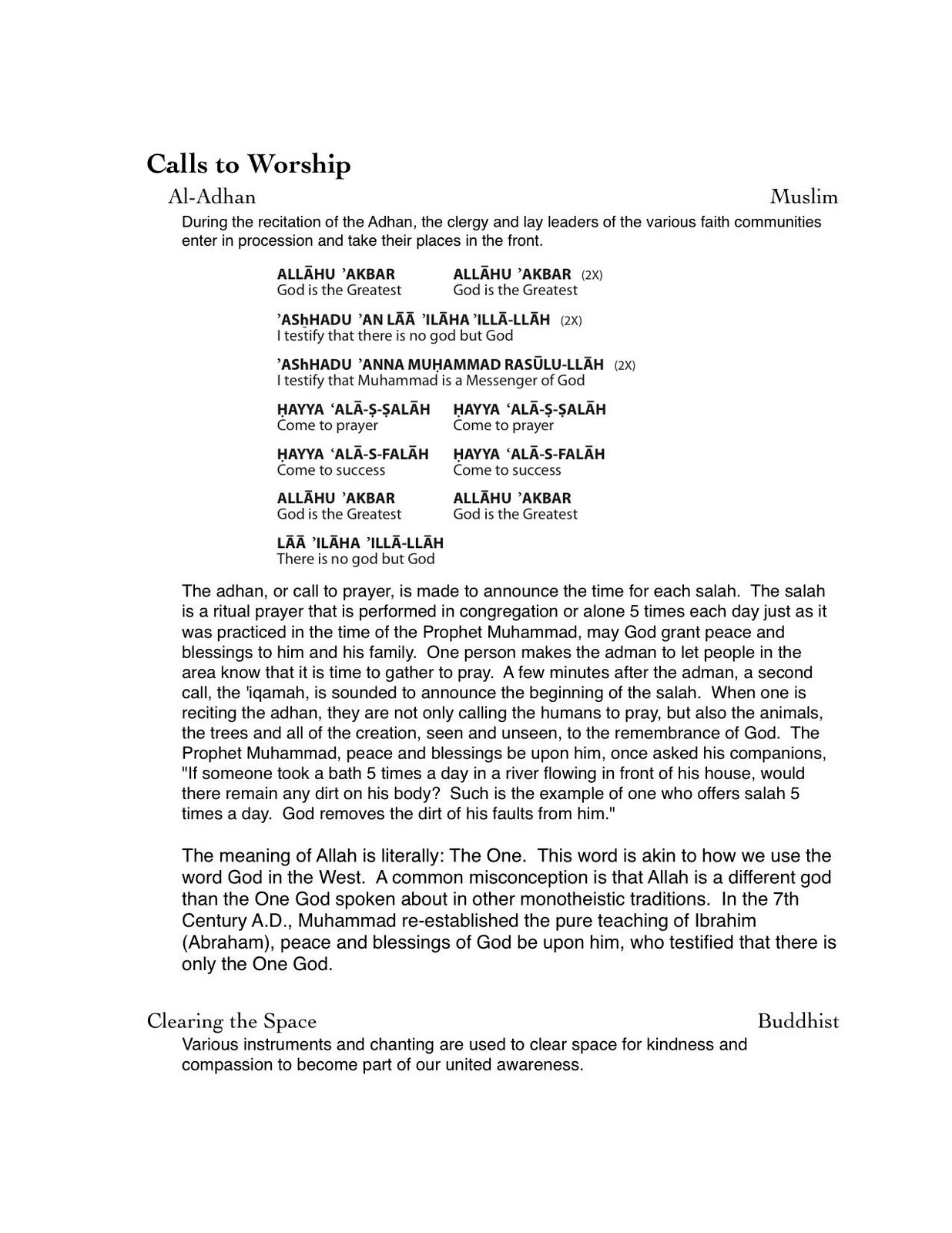
This year marks the third annual interfaith Thanksgiving Eve worship service on Phinney Ridge in Seattle. In the past two years, the service has attracted about 500 worshipers. It aims to make friends from strangers, to weaken growing tensions between religions, and to remind people that at the core of all major religions are shared values: compassion, justice, neighborliness, peace, kindness, and love.
More information about the service can be found on its facebook page.
I have been privileged to be part of the planning team for the past three years. I am proud to say that I have become friends with the other organizers. It is our goal to continue to build relationships throughout the year. We have been invited to worship at Masjid Umar Al Farooq and at Temple De Hirsch Sinai. And, at Woodland Park United Methodist Church this Advent, we are celebrating our anticipation of the birth of the Prince of Peace by inviting representatives from Muslim, Buddhist, and Jewish religions to come and teach us about the basic tenets of their faith, the role of peace in their faith, and the struggles in attaining peace that they face.
The service begins at 6:30 PM at Sakya Monastery of Tibetan Buddhism (108 Northwest 83rd Street) with spinning of the prayer wheels followed by a procession to Phinney Ridge Lutheran Church where the remainder of the service will begin at 7:30 PM. If you have mobility restrictions, feel free to attend only the service at Phinney Ridge Lutheran Church.
Cecile Hansen of the Duwamish tribe will introduce the offering.
The offering will benefit the Duwamish and Great Harvest Food Bank.
Sponsoring Organizations: Sakya Monastery of Tibetan Buddhism, Masjid Umar Al Farooq, Temple De Hirsch Sinai, St. John the Evangelist Roman Catholic Church, Phinney Ridge Lutheran Church, St. John United Lutheran Church, Luther Memorial Lutheran Church, Woodland Park Presbyterian Church, and Woodland Park United Methodist Church.
The public is encouraged to attend. Dessert and fellowship will follow the worship service. Childcare is provided.
Cecile Hansen of the Duwamish tribe will introduce the offering.
The offering will benefit the Duwamish and Great Harvest Food Bank.
Sponsoring Organizations: Sakya Monastery of Tibetan Buddhism, Masjid Umar Al Farooq, Temple De Hirsch Sinai, St. John the Evangelist Roman Catholic Church, Phinney Ridge Lutheran Church, St. John United Lutheran Church, Luther Memorial Lutheran Church, Woodland Park Presbyterian Church, and Woodland Park United Methodist Church.
The public is encouraged to attend. Dessert and fellowship will follow the worship service. Childcare is provided.


Thursday, November 04, 2010
All Saints Opening Prayer
Here is a prayer that we are using to open worship this Sunday, when we will honor the saints of our congregation, living and dead.
Holy are you and blessed is your name, Creator of heaven and earth. You sent your Son to live among us, to bless the afflicted, and to gather in the outcast. Blessed are all the saints, living and dead, who continue his holy work, who see your world as you do, who have caught sight of your holy vision, and rejoice in your mystical fellowship and communion. By their lives, may the wounds of this world be healed. By their witness, may your gospel be proclaimed. By their joy, may we all come into greater communion with you, O Holy One. Amen.
Wednesday, November 03, 2010
Video: Brian McLaren on Queries and Spiritual Disciplines
In the course of creating a video-based curriculum on spiritual practices, I have been privileged to meet a number of fascinating people, some of whom are famous, most of whom are not, all of whom are inspiring. In a conversation with Brian McLaren, he spoke about the power of queries to change how we experience the world. Here is a snippet of what he had to say. Just for the sake of context, I will say that the conversation in general was focused on Sabbath-keeping. I hope you enjoy this and if you are interested in hearing more about this project, please get in touch! I plan on sharing more tidbits from other conversations over the course of the next few months.
Sunday, October 31, 2010
Sermon: Dia del los Muertos - Nothing Separates Us from God and Each Other, Not Even Death
Sharing ourselves with another person changes the world. A bold statement, I know, but a true one all the same. When we share our stories, our vulnerabilities, our joys, our hopes, our dreams; when we commit to sharing a life with someone else; when we enter into another’s life, we are changed, they are changed, and something in the world is changed. Ripples of change emanate from that experience and move through the world shifting it this way and that. There is no scientific meter to measure this. There is no scientific hypothesis of which I am aware that really explains this. Yet it is a lived truth that people in all cultures and religions know. Being joined with another in a bond of love, with understanding and forbearance; being known, really known, and knowing another; these things reach into that part of us that stays hidden from the world and it works miracles there. With these people, these ones with whom we trust our tender places, we experience something that I only know to call “home.”
Yet, we live imperfect lives and carry scars, and we are are trapped by fears deeply established and rooted in our minds and souls. We build up walls to protect us from further pain and loss and disappointment and suffering. These same walls that protect us keep us from one another; they keep us stuck in pain or at least numbness; they keep us stagnate in life; they fragment a world that God is desperately trying to re-form into its intended wholeness.
We are living near the end of a period known as Modernity or the Enlightenment. Its birth pangs began long before, but it came into its own in the 1700s as societies moved from feudalism to nation-states, from agrarian economies to capitalism - a new idea altogether, and it is marked by the rise of democracy. One scholar has said that during this time we moved from the “divine right of kings” to the “divine right of the individual.” Germ theory rose to prominence as a way of explaining the spread of disease. People learned about atoms and subatomic structure. Once forbidden studies in human anatomy yielded to humankind’s need to know. Psychology developed as a new science that attempted to explain the “whys” of human behavior, and it sought to help the broken self heal. In the production world, the assembly line was developed. Technology provided humans with the ability to travel far distances in short periods of time. The world, which had up until this time been understood in whole terms, was dissected, reduced, pulled apart, named, categorized, and segmented. If one thing can be said about the past few hundred years, it is that it can be known primarily as a time of segmentation - of fragmentation. We have been able to parse the world down into mind-boggling units. And, with this never ending segmentation of the world and the increasing development of humans as individuals, we find ourselves living as completely separated people in a highly fragmented world.
Birth and death have not escaped this process of segmentation. More often than not, in industrialized countries where the technology and money exist, women receive their first baby photographs in their first trimester. We can prolong death in extraordinary ways. Our thinking, our ethics, our understanding have not caught up with our technological abilities. How we think about birth and death has become very privatized. We can scarcely understand a time when people did not understand themselves as individuals, wholly separate people, being born, living in the world, and dying. We have even made the separation between life and death much more pronounced that in previous times. Just in the past decade or so, it has become increasingly customary to hold memorial services without the body present. And it is now becoming increasingly common not to hold memorial services at all. Death has become final. Really final. Yet, we belong to a faith that does not distinguish between life and death in such stark terms. Life and death are not so far apart. And, God is active and present in them both. Throughout our scriptures, God is reaching in to dead places in order to pull out new life. When people seek out Jesus for a teaching, a healing, an exorcism, or to literally bring someone back to life, it isn’t just the individual who is changed. It is a holistic experience creating unity in whole communities. The world changes, not just the person. Jesus doesn’t just cure an illness or remove a demon or tell people to live good lives. Jesus restores communities. Through his life, his ministry, his suffering, death and resurrection, Jesus brings the wholeness of God’s kingdom and the unity of God’s shalom to life here on this earth.
Today we honor the Mexican holiday of Dia del los Muertos, Day of the Dead, which came into being when the native peoples of Mexico were introduced to Catholicism as the Spanish conquered Mexico in the 1500s. But we could just as easily give a nod to Samhain (sow-een), the Celtic Druid celebration out of which Halloween emerged. Both of these, Dia del los Muertos and Samhain are premodern celebrations. They are not encumbered by our scientific explanations or individualistic experiences of death. In every premodern culture that I know of, there is a ritual to honor the dead and to commune with the dead. For Dia del los Muertos, the belief is that the souls of the dead return to their homes on November 1, All Souls Day. So, on Oct 31, homes are prepared to welcome them. Altars are set up. Favorite foods are left out, in part to show them the way home and in part to welcome them with a feast once they’ve arrived. Bright marigolds are arranged to help souls find their way. Candles are lighted and incense is burned. Specifically, small candles are lit at 4 AM on Nov 1 for returning souls of children; they are blown out at 8 AM. At 3 PM large candles are lighted. Prayers are said at home and on November 2, people go to mass. The visual theme is the skeleton, specifically the skull. Displays are set up that show skeletons doing all of the joyful things that people do while they are alive: at weddings, at feasts, driving cars, playing musical instruments, even playing sports. The more whimsical the toy, the more true to the holiday. For some in our country this can seem macabre, but it isn’t. It is a way to celebrate that our relationships do not end at death. Loved ones remain a part of us. Their joys don’t cease to affect the world. Dia del los Muertos reminds us that death isn’t that big of a chasm. In Christianity we believe that the veil that separates the living and the dead is torn apart on this day. Death, despite its power, is not stronger than the love shared by people, even if they can no longer share the same physical place. And, their love continues to change the world, even after death.
When Jesus entered Jericho, the tax collector Zacchaeus climbed a tree to, we are told, “see who Jesus was.” I find this curious. He didn’t just want to see Jesus. He wanted to see who he was. When Jesus called him by name and told Zacchaeus that he would be eating in his home that day, Zacchaeus was changed. I don’t know if he at first saw who Jesus was, but Jesus saw who he was. And it was a powerful thing to be seen and known. Zacchaeus responded to Jesus with an offer to pay restitution to all whom he had harmed. This is real transformation born out of a shared experience. And to him, Jesus says, “Today salvation has come to this house.” Jesus says, “Wholeness has come to this house.” Not just to Zacchaeus, but to his whole house. I bet their feast was something pretty great.
We feast today, too. We feast in the assurance that nothing can separate us from the love of God. We feast at God’s table as the host of Christ himself. We break this bread and we feast in the presence of the saints and in the presence of the Holy Spirit. This is a mystical meal that crosses all the boundaries that try to keep us separated from one another and with God. In this meal, shared with the living and the dead, in the presence of the Most Holy, transformation occurs, not just in us. No. In the taking of this bread, in the sharing of this meal, by the confession of our mouths and in the prayers that we offer and in the stories that we retell, ripples are sent out into the world, and it is changed from this day forward.
God sends us to one another to share in this world and all that it has to offer. To share big and robustly, not to hid behind the walls that we erect, to be safe from one another. Shared life is risky life. Yet shared life is whole life - healing life - salvific life. Today we are reminded that nothing really separates us from one another or from God. As it is written in Romans:
Who shall separate us from the love of Christ? Shall trouble or hardship or persecution or famine or nakedness or danger or sword? 36As it is written:
"For your sake we face death all day long;
we are considered as sheep to be slaughtered."[l] 37No, in all these things we are more than conquerors through him who loved us. 38For I am convinced that neither death nor life, neither angels nor demons,[m] neither the present nor the future, nor any powers, 39neither height nor depth, nor anything else in all creation, will be able to separate us from the love of God that is in Christ Jesus our Lord.
Let it be so. Amen.
Subscribe to:
Posts (Atom)